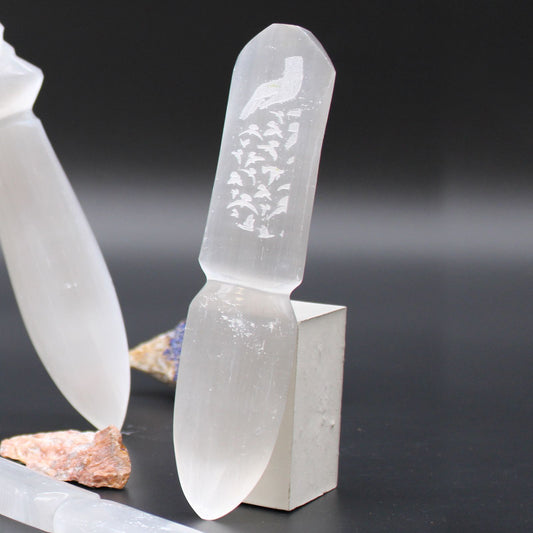
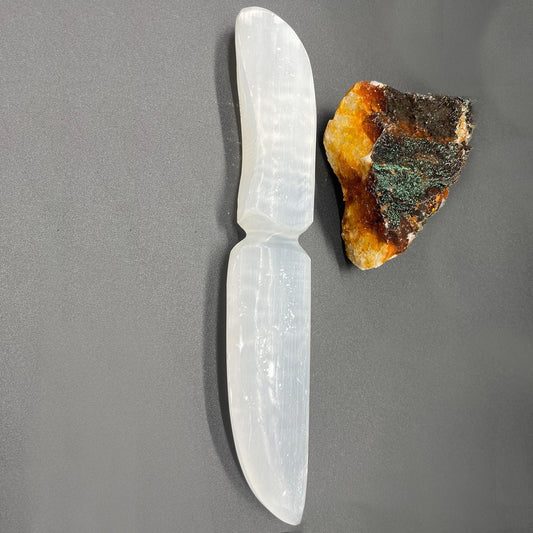
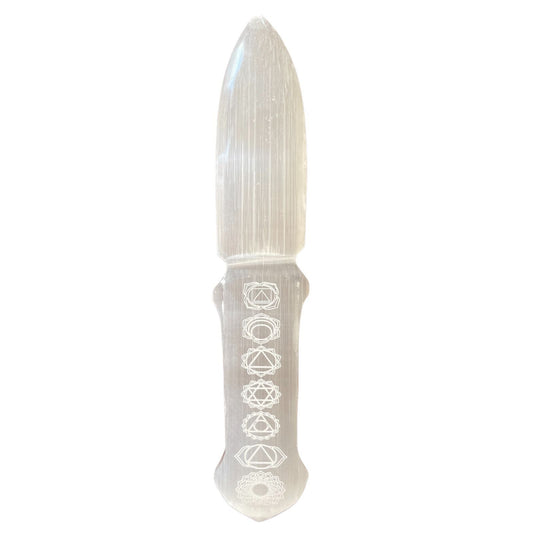
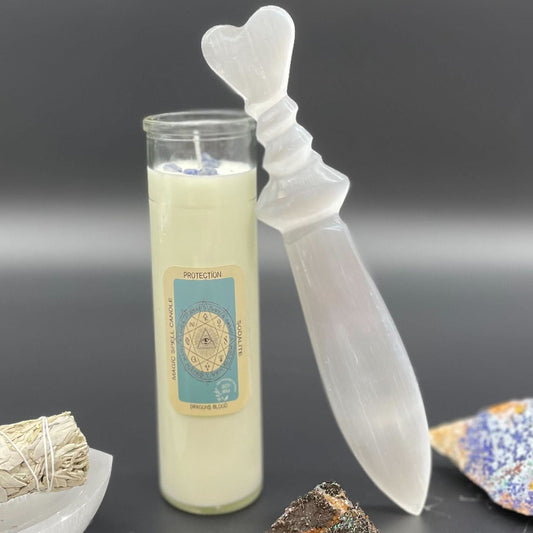
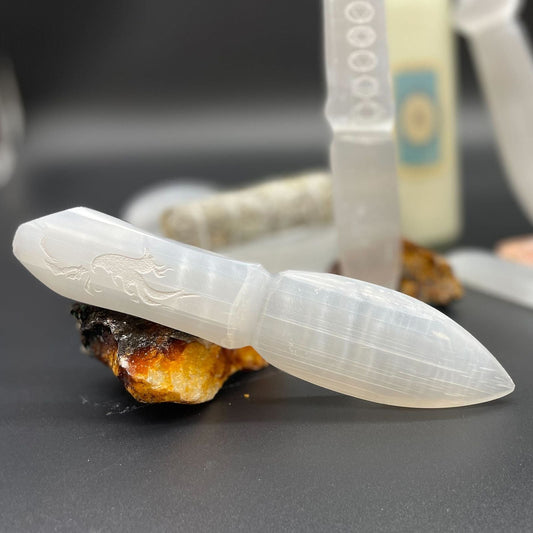
What Is a Selenite Ritual Knife?
A selenite ritual knife is a ceremonial tool carved from selenite into the symbolic shape of a blade.
Within modern witchcraft and spiritual practice, ritual knives may be used to direct intention, mark symbolic boundaries, support cleansing rituals or represent the act of releasing something that no longer feels useful.
Because selenite is a soft crystal, these knives are not designed for physical cutting.
Their purpose is symbolic and ceremonial.
What Is a Selenite Athame?
An athame is a ceremonial knife associated with several modern witchcraft traditions.
Traditionally, an athame is used symbolically rather than as an everyday cutting tool. Depending on the practice, it may be used to direct intention, mark ritual space or form part of an altar setup.
A selenite athame takes that traditional shape and combines it with the appearance and symbolism associated with selenite.
You may see the terms selenite athame, selenite ritual knife and selenite ceremonial knife used to describe similar ritual tools.
Selenite Ritual Knives for Cord-Cutting Rituals
Selenite ritual knives are often incorporated into symbolic cord-cutting and release rituals.
Within these practices, the knife represents the deliberate act of letting go of an unwanted attachment, habit, thought pattern or chapter of life.
The blade does not physically cut anything.
Instead, it is used as a visual and symbolic tool while setting an intention to release or move forward.
This type of ritual may be combined with journalling, meditation, candles or other meaningful practices.
Using a Selenite Knife for Cleansing Rituals
Selenite is commonly associated in crystal traditions with cleansing and clarity.
For this reason, some practitioners incorporate a selenite knife into rituals focused on clearing a space, resetting an altar or directing attention towards a particular intention.
A ritual knife may be gently moved through the space around an altar or held during meditation and intention setting.
How you choose to incorporate it into your own practice is entirely personal.
Selenite Athames for Witchcraft Altars
A selenite ceremonial knife can also simply form part of a witchcraft altar.
Its distinctive shape gives it a strong visual presence alongside other ritual tools such as:
- Altar cloths
- Altar bells
- Cauldrons and chalices
- Selenite bowls
- Crystals
- Candles
- Incense
- Tarot or oracle decks
You do not need every traditional ritual tool on your altar.
Choose pieces that have meaning or purpose within your own spiritual practice.
Ritual Knives for Intention & Release Work
Symbolic ritual tools can help give physical form to an otherwise abstract intention.
For example, during a release ritual, you might hold your selenite knife while thinking about something you are ready to leave behind.
Some people gently move the ritual knife through the air as a symbolic gesture of separation or change.
Others simply place it on their altar as a reminder of a particular intention.
There is no single required ritual or method.
Caring for a Selenite Ritual Knife
Selenite requires careful handling.
It is a relatively soft mineral and can scratch, chip or split if knocked or dropped.
Keep your selenite ritual knife dry and avoid immersing it in water, as prolonged moisture can damage the mineral.
To remove dust, gently wipe it with a clean, soft, dry cloth.
Store your knife somewhere secure where it will not be knocked against harder crystals or other objects.
Choosing a Selenite Ritual Knife
Different selenite ceremonial knives may carry different carved designs, symbols or intentions.
You may choose yours based on:
- The symbolism of its design
- A particular ritual intention
- Its appearance
- The way it fits into your altar
- The meaning you personally associate with it
For example, one ritual knife may be connected with letting go, while another may feel better suited to cleansing, protection or general altar work.
The best choice is the one that has meaning within your own practice.
Frequently Asked Questions
What is a selenite ritual knife used for?
A selenite ritual knife is a symbolic ceremonial tool that may be used during intention setting, cleansing rituals, cord-cutting practices, meditation or altar work.
It is not designed for physical cutting.
Is a selenite ritual knife the same as an athame?
The terms can overlap.
An athame is a ceremonial knife used within certain witchcraft traditions, while “ritual knife” is a broader term.
A blade-shaped selenite ritual tool may therefore also be described as a selenite athame.
What is a selenite athame used for?
Depending on the practitioner's tradition, a selenite athame may be used symbolically for directing intention, marking ritual space, cleansing work or release rituals.
Different witchcraft traditions use ceremonial tools differently.
Can a selenite ritual knife actually cut?
No.
Selenite ritual knives are symbolic spiritual objects rather than functional cutting blades.
Selenite is also a relatively soft mineral and should be handled carefully.
Can you use a selenite knife for cord cutting?
Some practitioners use selenite ritual knives in symbolic cord-cutting rituals.
In this context, the knife does not physically cut anything. It represents the intention to release an attachment, habit or situation.
Can I keep a selenite knife on my altar?
Yes.
Selenite ceremonial knives can be displayed on witchcraft altars alongside crystals, candles, altar cloths, bells, cauldrons and other ritual tools.
Can selenite get wet?
It is best to keep selenite dry.
Because selenite is a soft form of gypsum, prolonged exposure to moisture can damage its surface.
Clean your ritual knife gently using a soft, dry cloth.
Do I need an athame to practise witchcraft?
No.
An athame or ritual knife is entirely optional.
Different practitioners use different tools, and many forms of spiritual or witchcraft practice do not require ceremonial knives at all.
Are selenite ceremonial knives suitable for beginners?
Yes, provided they are understood as symbolic ritual tools.
A beginner may choose to use one for altar work, intention setting or meditation without needing to follow any particular ritual system.